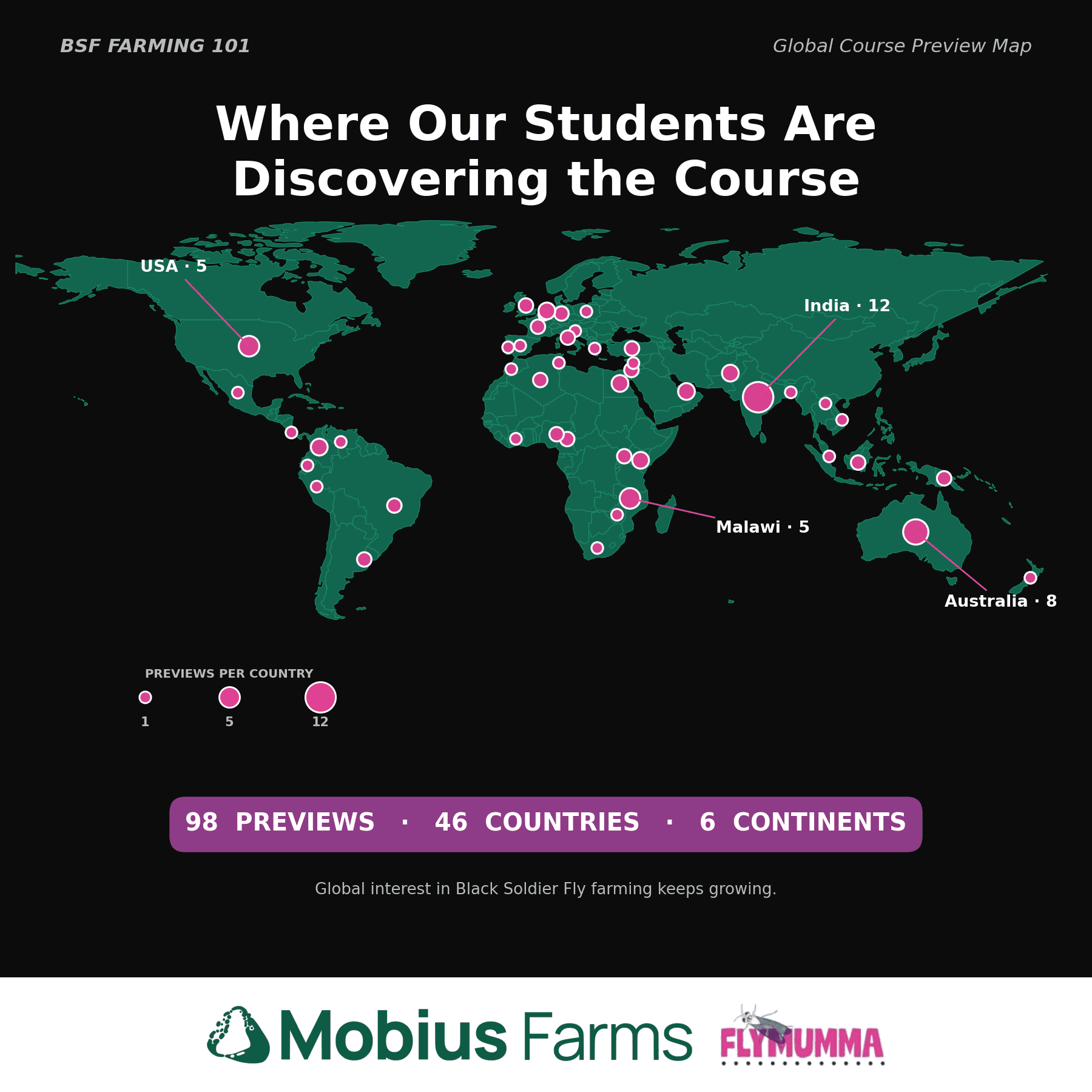
A few weeks ago, we pulled the numbers on who'd been previewing BSF Farming 101, our new online course for black soldier fly farmers. We expected a solid showing from Australia and a handful of familiar names overseas. What we got was a map covered in dots — 98 course previews from 46 countries, spanning six continents. Malawi. Laos. Papua New Guinea. Lebanon. Zimbabwe. People who had never met us, in places we've never farmed, were quietly checking out a course built in a shed in the Barossa Valley, South Australia, Australia. That map is the reason we're writing this post. It's proof of something we've believed for a while: the world doesn't have a black soldier fly problem, it has a black soldier fly information problem — and it's a bigger, more global problem than we realised.
The information problem no one talks about
Anyone who has tried to start a black soldier fly (Hermetia illucens) colony from scratch knows the drill. You watch a few YouTube videos. You skim an academic paper that answers a laboratory question, not a farming one. You find a forum thread where three people disagree and nobody says why. Then you buy some larvae, put them in a bucket, and hope. That's exactly how Mobius Farms co-founder Jeannine Malcolm got started, trying to solve an organic waste problem on a local pig farm with no map to follow. It's a story we hear on repeat from people who reach out to us — smart, capable people who simply didn't know who to ask or where to begin. Multiply that by every country on our preview map, and you start to see the scale of the gap.
Two farmers, one course
BSF Farming 101 is our answer to that gap, and it's Australia's first structured online course for black soldier fly farming. Mobius Farms designed and built it with FlyMumma, whose founder, BSF educator and larval nutritionist Sofia Katzin, spent years turning her own hard-won lessons into something beginners can actually use. Between Jeannine and Sofia, that's years of colony management, waste-stream design and troubleshooting distilled into a course, rather than scattered across forum threads. Put the course in the hands of communications and marketing expert and insect industry ambassador, Rodrigo Llaurado Casares, and the impact has been impressive for such a small team.
Two ways to work through it:
- Digital Access — self-paced, lifetime access to every module, narrated video lessons, downloadable resources and a certificate of completion. Built for people exploring the sector on their own schedule.
- The Facilitated Program — the same content, plus live weekly coaching in a small cohort, direct feedback on your own setup, and a private community of fellow students who are figuring it out alongside you.
Either way, you walk away able to set up and manage a colony from scratch, harvest and process BSFL, troubleshoot the problems every small producer eventually hits — mould, escapee larvae, colony collapse — and design a waste-conversion system that actually fits your context.
Turning heads beyond Australia
The global preview map isn't the only sign this has struck a nerve. BSF Farming 101 was recently featured by Feed & Additive Magazine in their Alternative Proteins issue, covering the course launch alongside the bigger story of why insect farming education matters right now. As Sofia put it in that piece, the course is designed to be a shortcut: "everything I wish I'd known before I started, minus the expensive mistakes." It's a neat summary of the whole project. More than 70% of countries still lack clear regulatory frameworks for insect protein, and the sector's growth depends as much on well-trained producers as it does on policy or funding. Every person who starts a colony properly, instead of guessing in a bucket, is one more data point for an industry trying to prove itself at scale. Recently, access to the BSF Farming 101 program was granted to the Refugee youth Team at Dzaleka BSF Farm, Malawi 🇲🇼. Dzaleka Team member, Louis Msewa posted on Linkedin, "This course has expanded my knowledge of Black Soldier Fly (BSF) farming, sustainable waste management, and the role of insect farming in advancing resilient and sustainable agricultural systems. My sincere appreciation goes to the instructors and the teams at Mobius Farms and FLYMUMMA for delivering such a valuable learning experience." We couldn't be happier to create such positive impact. 🤩
Why this matters for the industry
Australia is home to only a handful of companies farming black soldier fly commercially, but the barrier to entry for new players wasn't always a need for capital — it was knowing where to start, and a support network to keep going. A sector built on well-trained, well-supported small farms is one that can speak with a coherent voice to regulators, investors and buyers. That's the circular economy in action: not just larvae eating food waste, but knowledge moving from the people who've done it to the people about to try.
FAQs
Who is BSF Farming 101 for? Complete beginners and early-stage producers. No prior insect-farming experience is needed.
What does the course actually cover? The full production cycle — BSF biology, breeding and hatching, rearing and pupation, BSFL diets and processing, and troubleshooting — plus guidance on turning your setup into a working waste-conversion system.
Is this only relevant to Australian farmers? Not at all. The biology and systems taught apply globally — which is exactly why previews have come in from 46 countries so far.
Ready to get the bug?!!
BSF Farming 101 is live at shop.mobiusfarms.com. Head over for current pricing, format options and upcoming Facilitated Program dates — or subscribe to our newsletter to be the first to know when the next cohort opens.
*Have questions about which format is right for you? Reach out at info@mobiusfarms.com — we'd love to hear from you, wherever in the world you're farming from.